Financial Services: Multi-Branch Attendance Management
2026-10-09

- Attendance Management Challenges by Organizational Structure
- Work Arrangement Examples Across Financial Services Organizations
- Integrated Attendance Management Standards for Multi-Branch Financial Institutions
- Integrated Attendance Management for Financial Services with Shiftee
- Frequently Asked Questions (FAQ)
Financial institutions may have a wide range of work environments and arrangements across head offices, branches, customer-facing teams, and other organizations within the same company. Office employees at the head office, customer-facing branch employees, and teams operating around set business hours may require different approaches to work schedules and clock-in and clock-out times. Attendance management in financial services should therefore reflect the actual work arrangements of each organization while maintaining consistent company-wide standards.
For financial institutions operating multiple branches, it is important to manage not only work schedules and clock-in and clock-out records by organization, but also leave, overtime, data access permissions, and approval processes within a common company-wide framework. In this article, we look at work arrangements and attendance management methods across financial services organizations and review the key considerations for managing a head office and multiple branches within a single attendance management system.
Attendance Management Challenges by Organizational Structure
In financial services, attendance management needs to account for differences in work arrangements across organizations and positions. Head office employees may work fixed hours or use flexible work arrangements, while branch employees need work schedules that reflect the operating hours and responsibilities of each workplace. Organizations such as call centers that operate shifts also need to manage shift schedules, break times, and schedule changes together.
When multiple work arrangements operate within the same company, it is advisable to establish a framework that allows work arrangements and approval rules to be managed separately by organization and position rather than applying the same attendance management approach to every employee. Companies should also consider whether they can manage clock-in and clock-out records, work schedules, leave, and other attendance data from the head office and multiple branches according to consistent standards while configuring the access permissions and approval processes required by each organization.
Work Arrangement Examples Across Financial Services Organizations
Work arrangements in financial services can vary depending on organizational structure, position, and actual work environment. Rather than applying a specific arrangement solely based on whether employees work at a head office, branch, or call center, it is important to establish management standards that reflect how each organization actually works. The following examples illustrate how attendance management can be structured when organizations use flexible work arrangements, operate multiple branches, or manage shift work.
Example 1. Flexible Work Arrangements at the Head Office
If a head office operates flexible work arrangements such as staggered working hours or selective working hours, applying the same clock-in and clock-out times to every employee may not be appropriate. A suitable approach is to review clock-in and clock-out records and working hours against each employee's scheduled working time and operate separate request and approval processes when overtime, night work, or holiday work is required. In this environment, the key is to align each employee's varying working hours with their work schedules.
Example 2. Operating Multiple Branches
When a financial institution operates multiple branches in addition to its head office, defining management scopes and access permissions for each workplace can become a key consideration. Attendance data can be separated based on each employee's organization and workplace, with permissions configured so branch managers can access information for the organizations they manage while the head office manages data across multiple branches within an integrated framework. As the number of branches increases, it becomes increasingly important to clearly define data access scopes and approvers based on the organizational structure.
Example 3. Shift Work in Call Centers and Similar Organizations
When organizations such as call centers operate shift work, the key is planning and managing schedule changes by shift. If morning, afternoon, and other shifts recur regularly, schedules can be planned based on recurring work patterns and adjusted when employees take leave or change shifts. Managing employees according to planned shifts and actual work schedules rather than fixed clock-in and clock-out times is better suited to shift-based operations.
Integrated Attendance Management Standards for Multi-Branch Financial Institutions
For financial institutions operating a head office and multiple branches, it is important to establish a structure that distinguishes operating practices by organization within common company-wide standards rather than managing attendance data separately for each workplace. Configuring work arrangements and approval rules by organization and position while managing work schedules, clock-in and clock-out records, leave, and other attendance data across branches within a single framework can help reflect different work arrangements while maintaining consistent management standards.
As the number of organizations and branches increases, it is particularly important to clearly define data access permissions and the scope of approval authority. Access can be configured so that head office HR teams and managers in each organization can review the attendance data they need, while approval rules can be set by request type, organization, branch, and position. This allows companies to build attendance management processes that reflect the characteristics of each organization rather than applying the same operating model everywhere.
Integration with existing HR systems is another consideration when adopting an attendance management system. Companies can consider connecting organizational and employee information managed in ERP with the attendance management system or using Open API to exchange data between systems. If the company uses a centralized authentication framework, it is also advisable to review SSO support and system access controls to determine whether multi-branch attendance data and system access standards can be managed together.
When evaluating an attendance management system for a multi-branch financial institution, companies should review support for work arrangements and approval rules by organization and position, branch-level data access permissions, integrated management of work schedules, clock-in and clock-out records, and leave, as well as integration with existing HR systems and access security.
Integrated Attendance Management for Financial Services with Shiftee
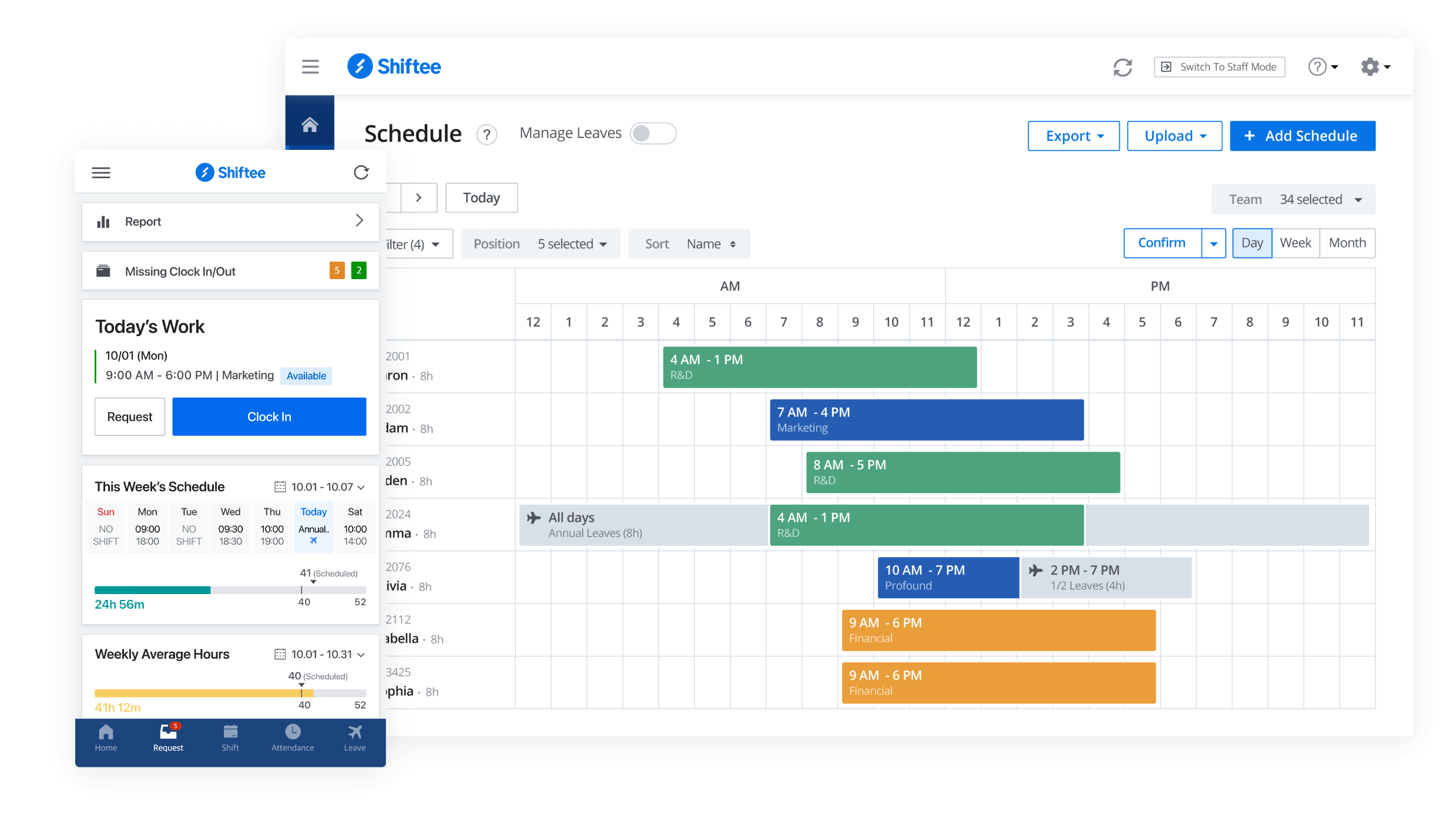
Shiftee is an integrated workforce management solution that can reflect complex organizational structures across a head office and multiple branches. Multi-branch attendance management in financial services requires companies to consider work schedules, clock-in and clock-out records, data access permissions, and approval rules by organization. With Shiftee, attendance data and approval structures across multiple organizations and branches can be managed within a single system.
1. Integrated Management of Multiple Teams and Locations
Shiftee can support complex organizational structures consisting of multiple teams and locations (branches), allowing attendance data to be managed by each team using parent team and main team features. Excluding the Owner, three access levels—Manager, Supervisor, and Staff—can be assigned, while approvers can be configured separately for each team or location.
2. Diverse Work Schedules and Shift Management
Daily, weekly, and monthly calendar views and schedule pattern features allow work schedules for different work arrangements to be managed across teams and locations. For shift-based operations, schedule patterns can be used to plan schedules, while shift templates and leave types can be incorporated when adjusting schedules. Rule-based automatic schedule creation can also be used to generate schedules based on recurring work patterns.
3. Workflow Approval Rules by Team, Location, and Position
Shiftee supports requests and approvals for work schedules, leave, and other attendance-related processes, with approval rules configurable by request type, team, location, and position. It supports approval structures that reflect the organization's approval process, including single and sequential approvals, multi-step approvals based on request conditions, and designated approvers and followers.
4. ERP and Open API Integration
Shiftee supports integration with ERP systems such as SAP, Workday, and Oracle, as well as internal company systems. Required data can be connected through Open API or custom integrations based on the company's system environment.
5. SSO and Access Security
Shiftee supports access through SSO systems including Okta, Microsoft Azure, and OneLogin. Access can also be restricted to designated IP addresses, while company audit logs allow administrators to review records of data creation, modification, and deletion.
Frequently Asked Questions (FAQ)
Q. How Should Financial Institutions Manage Attendance Data Across Multiple Branches?
Financial institutions operating multiple branches should apply consistent company-wide attendance management standards while managing work arrangements, data access permissions, and approval rules separately by organization and branch. It is also advisable to confirm whether key attendance data such as work schedules, clock-in and clock-out records, and leave can be managed within a single attendance management system.
Q. Can the Head Office and Branches Use the Same Attendance Management System If Their Work Arrangements Differ?
Yes. An attendance management system that allows work arrangements and approval rules to be configured by organization and position can support different work environments within a single management framework. It is advisable to check whether the system supports schedule management and approval processes that reflect actual working conditions, including flexible work at the head office, branch-specific schedules, and shift work.
Q. What Features Should Be Reviewed When Adopting a Multi-Branch Attendance Management System?
When adopting a multi-branch attendance management system, it is advisable to review work schedule and clock-in and clock-out management by organization and branch, data access permissions, approval rules, and integration with existing HR systems. Companies using a centralized authentication framework can also review SSO support and system access controls.
Attendance management in financial services requires companies to maintain consistent standards across the organization while reflecting different work environments across the head office, branches, and shift-based teams. When adopting an attendance management system, it is therefore advisable to review whether work arrangements and approval rules can be configured by organization and position and whether attendance data such as work schedules, clock-in and clock-out records, and leave can be managed across multiple branches within an integrated framework.
Shiftee supports attendance management across multiple teams and locations, diverse work schedules, approval rules by team, location, and position, ERP and Open API integration, and SSO. If you are considering how to manage work arrangements across a head office and multiple branches within a single attendance management framework, consider adopting Shiftee based on your organization's structure and work environment.
When citing the content, be sure to indicate the source according to copyright law.