2026 Guide to Efficient Attendance Management Automation
2026-06-12

The HR environment in 2026 is evolving rapidly. As hybrid work becomes more common, organizations increasingly manage office employees, field workers, and shift workers within the same workforce. However, some companies still manage working hours primarily through basic clock-in and clock-out records, which can create gaps between actual work practices and recorded data.
Companies are adopting a variety of approaches, including location-based clock-in and clock-out methods and ERP integration. However, maintaining consistency in HR operations requires these methods to be integrated and managed under a unified framework. Attendance management is increasingly moving beyond simply recording time toward connecting work schedules with actual working hours.
In this article, we look at why attendance management automation is gaining attention in the changing HR environment of 2026 and the key steps to consider when adopting it.
How Can Companies Manage Attendance More Efficiently?
To manage attendance more efficiently, companies should first establish a framework that connects work schedules with actual working hours and standardize approval processes for overtime, night work, and holiday work. They can also consider using mobile apps and ERP integration to organize working time data within a consistent flow.
Managing these elements together in a single system can help maintain clearer operating standards while reducing repetitive administrative work. The use of mobile attendance management apps to manage both field and office-based employees within the same framework is also becoming increasingly common.
Attendance management automation refers to a framework that connects work schedules, clock-in and clock-out records, and approval workflows within a single system to manage working hours according to consistent standards. It goes beyond simply recording time and is closer to an operating structure that defines an organization's working standards and manages them based on data.
Key Considerations When Adopting Attendance Management Automation
Attendance management automation should be viewed not simply as adopting a new system, but as an opportunity to refine existing operating standards and approval processes at the same time. Companies are more likely to establish an effective framework when they first define how working hours will be calculated, how approval histories will be managed, and how accumulated data will be used in HR operations.
1. Build a Working Time Calculation Framework Based on Work Schedules and Attendance Records
Connecting work schedules with actual clock-in and clock-out records allows companies to compare planned and actual working hours according to the same standards. This can help maintain greater clarity and consistency in working time calculations.
2. Standardize Approval Workflows and Maintain Approval Histories
It is advisable to manage overtime, leave, and schedule change requests through standardized workflows and make approval histories available within the system. This helps organizations apply operating standards consistently.
3. Manage Overtime, Night Work, and Holiday Work Separately
Separating working hours by work type provides a clearer reference for payroll processing and HR reporting. This also creates a foundation for using working time data more broadly across HR operations.
4. Design an Integrated Management Structure for Multiple Workplaces
Defining organizational permissions and shared standards in advance allows attendance data from multiple workplaces to be managed within a single framework. This can be particularly useful for companies operating multiple locations, where maintaining consistency across sites is important.
5. Develop a Strategy for Using Working Time Reports
Rather than treating working time data as simple aggregated figures, companies should define how it can support HR decision-making and operational reviews. Clarifying report items and their intended use can help establish a more effective data-driven management framework.
4 Steps and a Checklist for Attendance Management Automation
Attendance management automation is not simply about replacing an existing system. It is closer to refining existing working time management methods and approval processes together. For more stable adoption, a phased approach that reviews and expands capabilities over time can be more practical than introducing every function at once.
Step 1: Review Current Attendance Management Practices
Start by reviewing how work schedules and clock-in and clock-out records are currently managed, along with approval processes for overtime and holiday work. Identify areas where spreadsheets or manual processes are still used and determine whether working time calculation standards have been documented. This review can help clarify the direction for subsequent system design and serves as a starting point for objectively understanding the current operating structure.
Step 2: Align Internal Policies with System Settings
The next step is to confirm whether working time calculation standards match actual operating practices and ensure that rules specified in workplace regulations or internal HR policies are aligned with system settings. If policies and systems are managed separately, operating standards may not be applied consistently. Aligning them at this stage provides the foundation for an automated framework.
Step 3: Define the Scope of ERP and Access Control Integration
If the company already uses ERP or access control systems, it is advisable to define in advance how much data will be integrated when adopting attendance management automation. In particular, where working time data connects directly with payroll processing, clearly defining data flows and areas of responsibility can support more consistent operations.
Step 4: Plan a Phased Adoption and Expansion Strategy
Rather than implementing every function at the same time, companies can prioritize key areas and introduce them gradually. Starting with a specific organization or function and expanding based on operational experience can support organizational adaptation and internal adoption. This is a practical approach to improving the effectiveness of attendance management automation.
✔ Pre-Adoption Checklist
| Key Pre-Adoption Checklist | Items to Review and Prepare | |
|---|---|---|
| Standards | Are work schedule and working time calculation standards clearly defined? | Break times, flexible work arrangements, rules for lateness and early departure, etc. |
| Processes | Are approval workflows for overtime, night work, and holiday work clearly structured? | Pre- and post-approval workflows and methods for retaining supporting records |
| System Integration | Has the scope of integration with ERP and access control systems been reviewed? | Available APIs and plans for validating data consistency |
| Permissions | Are organizational permissions and data access scopes clearly defined? | View and edit permissions for administrators, department heads, and employees |
| Data Usage | Is there a plan to use working time data in reports? | Identify data points for HR decision-making and payroll integration |
Building an Automated Attendance Management Framework with Shiftee in 2026
Attendance management in 2026 is moving beyond individual functions toward a connected structure that brings work schedule planning, working time calculation, approval histories, and data integration together in a single flow. In response to these changes, companies should establish a framework that manages attendance and workforce management functions according to consistent standards.
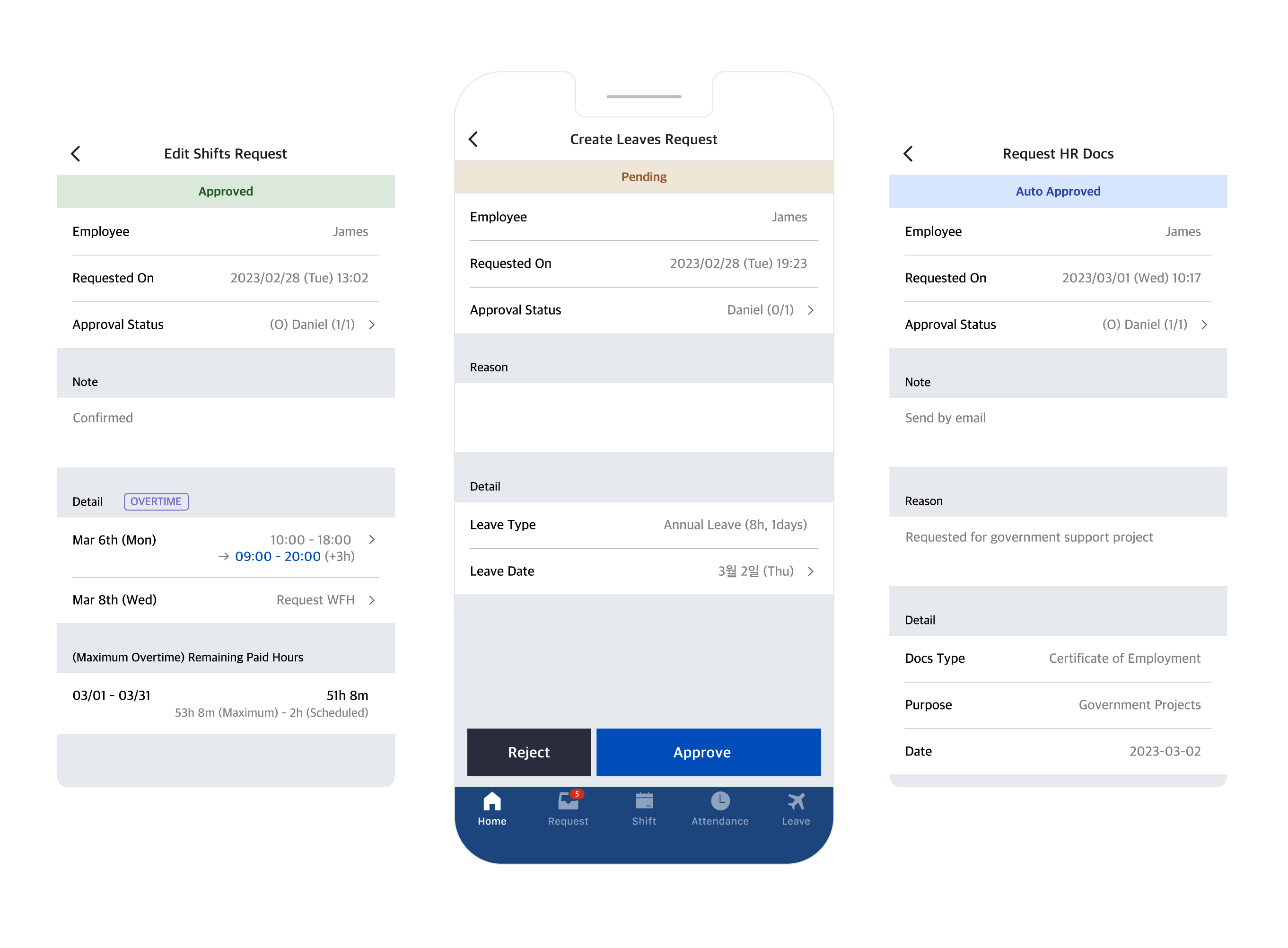
Working Time Calculation Based on Work Schedules and Attendance Records
Working hours can be managed based on predefined work schedules and actual clock-in and clock-out records. Comparing planned schedules with actual work records helps maintain consistent standards and provides greater clarity when applying working time calculation rules.
Location-Based and Wi-Fi Authentication for Attendance Management
Clock-in and clock-out records can be managed using location-based or Wi-Fi authentication to suit different work environments. Organizations that manage both office-based and field employees can apply the same working time management framework across their workforce.
Overtime, Night Work, and Holiday Work Management
Overtime, night work, and holiday work hours can be managed separately, allowing companies to review data systematically by work type. This information can also serve as a clear reference for payroll processing and HR reporting.
Data Management Through ERP and Access Control Integration
Attendance and HR data can be managed together through integration with existing ERP and access control systems. Designing the data flow in advance can help companies maintain consistent management standards.
Attendance management in 2026 is expanding beyond basic clock-in and clock-out records into a strategic area that defines working standards and manages working time data systematically. As hybrid work environments become more common and working time management requirements grow more sophisticated, companies with consistent, data-driven automation frameworks can build more stable HR operations.
Data-driven automation is becoming increasingly important for business competitiveness in 2026. Now is the time to review existing attendance management practices with Shiftee and consider moving toward an integrated workforce management framework.
When citing the content, be sure to indicate the source according to copyright law.