Enterprise HR Solutions: 7 Criteria for Large Companies
2026-09-07

As companies grow, their HR operating environments become more complex. Many organizations now manage multiple legal entities and workplaces, diverse organizational structures, and different work arrangements by position within a single company. As flexible work, shift work, remote work, and other arrangements become more common, attendance management alone may no longer be enough to manage the workforce efficiently across the organization.
In response to these changes, many large companies are considering enterprise HR solutions. An enterprise HR solution goes beyond managing clock-in and clock-out records or leave. It is an HR platform designed to manage workforce operations across the organization within an integrated framework. For companies that need to consider integration with existing systems such as ERP and groupware, organization-level permissions, and multiple work arrangements, these capabilities become especially important selection criteria.
Enterprise HR solutions are HR systems designed to manage diverse work arrangements and organizational structures across large organizations within an integrated framework. When evaluating a solution, companies should review not only its features but also whether it supports a management framework suited to their organizational scale and operating model.
What Is an Enterprise HR Solution, and How Is It Different from a Standard HR Solution?
Enterprise HR solutions are workforce management systems designed for complex organizational environments, such as large companies or businesses operating multiple workplaces. While standard HR solutions are often used for specific areas such as attendance or leave management, enterprise HR solutions are designed to support organizational structures, access permissions, work arrangements, and system integrations within a single environment.
Large companies often undergo organizational restructuring and employee transfers, and different workplaces may operate under different working rules. Capabilities such as configuring work arrangements by organization, setting approval steps, and managing data access permissions are therefore important considerations.
Another key element of enterprise HR solutions is connecting data with ERP, groupware, and collaboration tools to maintain continuity across HR operations. As organizations grow, it becomes increasingly important to determine whether an HR system can support integrated operations rather than focusing only on individual attendance management features.
Why Large Companies Adopt Enterprise HR Solutions
One of the main reasons large companies adopt HR solutions is to manage complex organizational structures and diverse work arrangements according to consistent standards. When workplaces are distributed across multiple regions or companies also operate overseas entities, it is advisable to manage work schedules, clock-in and clock-out records, leave, workflow-based requests and approvals, and other HR processes within a consistent framework.
Demand for better use of HR data is also increasing. To make effective use of working time data, organization-level operational data, leave usage histories, and other information, companies need an environment where data distributed across multiple systems can be managed together.
As companies grow, new organizations and workplaces are also more likely to be added. To respond flexibly to these changes, it is advisable to consider an enterprise HR solution that offers both scalability and stable operations.
7 Criteria to Review Before Adopting an Enterprise HR Solution
1. Does It Support Diverse Organizational Structures and Work Arrangements?
Large companies often operate multiple organizational structures, including headquarters, branches, and affiliates, alongside various work arrangements. It is therefore advisable to check whether an enterprise HR solution can flexibly support settings by organization and position, as well as staggered working hours, selective working hours, flexible working hours, shift work, and other work environments.
2. Does It Integrate with ERP and Existing Systems?
Seamless integration with existing ERP, groupware, and collaboration tools is another important consideration. If an enterprise HR solution can connect data with existing systems, companies can improve HR operational efficiency while maintaining continuity across their workflows.
3. Does It Provide Access Control and Security?
HR systems contain important employee data, making security another key area to review. An enterprise HR solution that supports capabilities such as IP access control, SSO, audit logs, and information security certifications can help organizations establish a more consistent and secure operating environment.
4. Can It Scale with a Large Workforce?
As companies grow, the number of organizations and workplaces may continue to increase. It is therefore advisable to confirm that an enterprise HR solution can flexibly add new organizations and employees and support operations across multiple workplaces as the business expands.
5. Can It Manage Different Work Environments in One System?
Another important consideration is whether office-based, production, field, remote, and shift-based employees can all be managed within a single system. An enterprise HR solution should support consistent operating standards across a wide range of work environments.
6. Does It Support HR Data and Reporting?
Companies should also review whether attendance and workforce data can be viewed and used in different formats. An enterprise HR solution that provides reports and Excel downloads can help support HR operations and workforce-related decision-making.
7. Is It a SaaS HR Solution Designed for Ongoing Operations?
Because enterprise HR solutions are used over the long term, a stable operating framework is also important. Reviewing whether the solution provides a cloud-based SaaS environment and ongoing maintenance can help support long-term operations.
Shiftee: Integrated Workforce Management for Large Enterprises
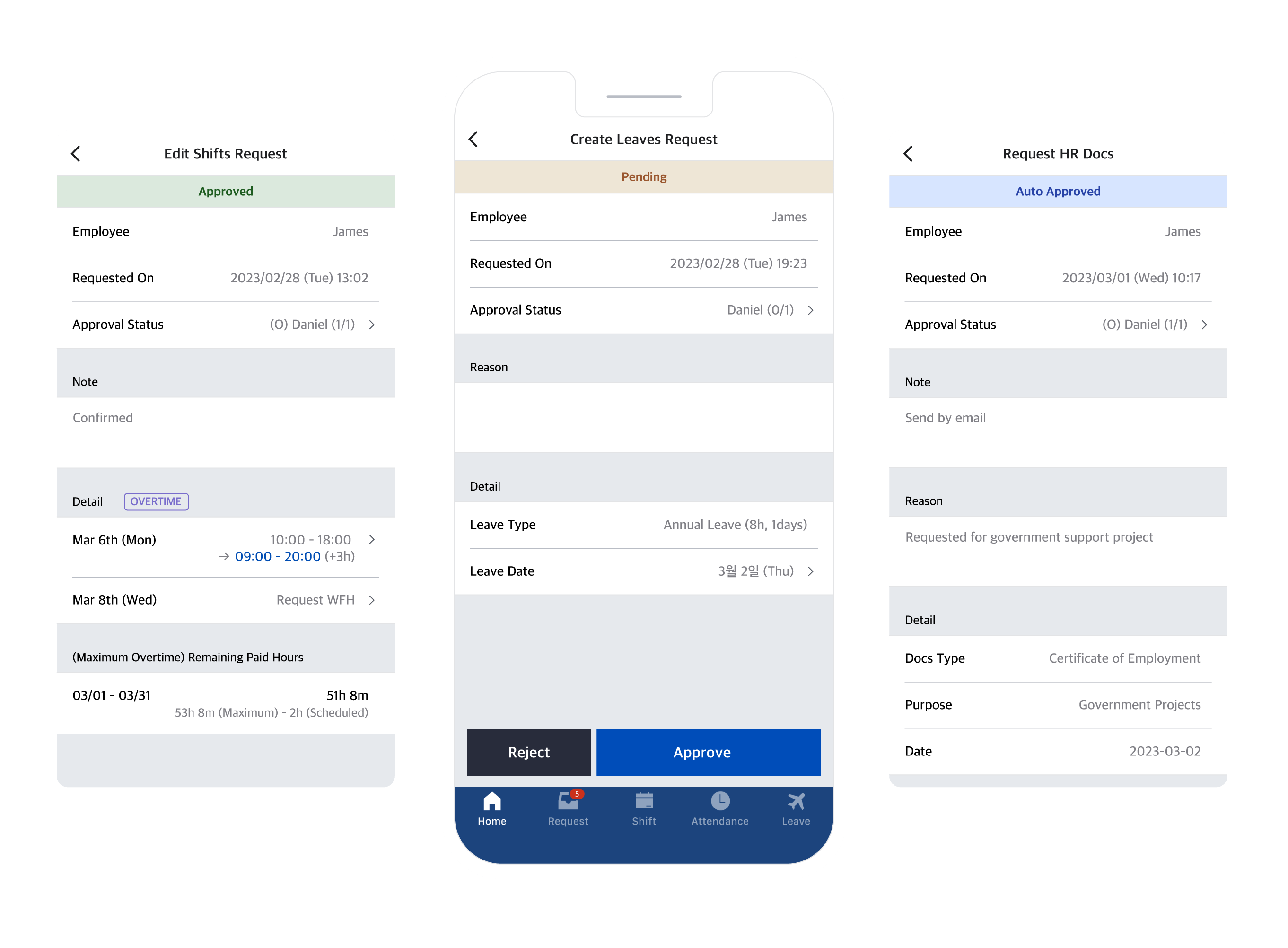
HR systems for large companies need to account for diverse organizational structures and work arrangements, integration with existing systems, security, and scalability. Shiftee is a SaaS-based integrated workforce management solution that supports attendance and workforce management within a single platform and can be configured to reflect different organizational operating models.
1. Support for Diverse Work Arrangements
Shiftee supports settings for staggered working hours, selective working hours, flexible working hours, shift work, and other work arrangements, allowing organizations to configure operations based on different workplace requirements.
2. ERP and Open API Integration
Shiftee supports integration with SAP, Workday, and Oracle ERP, as well as Open API connectivity, allowing companies to configure connections with internal systems based on their operating environment.
3. Team- and Position-Level Permissions and Approvals
Work arrangements and approval rules can be configured by team/branch, while approval position and data access permissions can be set according to the organization's operating structure.
4. HR Data Reporting
Shiftee provides more than 100 report columns and custom reports, while attendance data can also be downloaded in Excel format for use in HR operations.
5. SaaS-Based Integrated Workforce Management
Shiftee provides a cloud-based SaaS environment that can be used across multiple workplaces and organizations without requiring separate hardware installation.
Enterprise HR solutions are HR systems designed to manage diverse work arrangements and organizational structures across large organizations within an integrated framework. As organizations grow, companies need to consider multiple work arrangements, complex organizational structures, and different business systems together, making it important to choose a solution suited to their operating environment.
Support for organizational structures, ERP integration, access permissions, scalability, diverse work environments, HR data utilization, and a SaaS operating framework are among the key criteria worth reviewing when evaluating an enterprise HR solution.
Shiftee supports many of the key capabilities large companies consider, including diverse organizational structures and work arrangements, ERP and Open API integration, team- and position-level access management, more than 100 report columns, and a SaaS-based operating environment. Companies evaluating enterprise HR solutions should review whether these capabilities align with their own operating model.
When citing the content, be sure to indicate the source according to copyright law.