Integrated Scheduling for Hotel & Hospitality Teams
2026-06-16
Hotels, resorts, serviced residences, and other accommodation businesses operate around the clock, with departments such as front desk, housekeeping, food preparation, and facilities management working in shifts. As working-hour compliance requirements have become more important, establishing consistent working time standards while maintaining service quality has become a key priority for HR and general affairs teams.
Workforce management in the hotel and hospitality industry is now recognized as more than an administrative function, directly affecting operational efficiency, labor cost structures, and service responsiveness. In this article, we look at strategies for centrally managing departmental work schedules and how to operate them more systematically.
The Complexity of Workforce Management in Hotels and Hospitality
Hotels are a typical shift-based industry. Front desk teams may operate on three shifts, housekeeping may use daily schedules, and kitchen teams may be divided into morning and afternoon shifts. When these different work arrangements are managed manually or through separate systems by department, managers may face additional operational burdens such as adjusting staffing, calculating working hours, and managing approval workflows.
-
Complexity of workforce allocation: When departmental schedules are not connected, workforce allocation may become less efficient. For example, if front desk check-in peak times do not align with when housekeeping completes room cleaning, additional coordination may be required during guest service operations.
-
Limited visibility into working hours: When working time data is not integrated, it can be difficult to understand working hours across the entire workforce at a glance. In such cases, HR teams may need additional verification processes to manage overtime and compliance with prescribed working-hour limits more systematically.
-
Inconsistent approval processes: If schedule changes or leave requests are handled differently by each department, approval workflows may become inconsistent. Informal approvals through email or messaging tools may result in missing records, making a clearer and more structured approval framework preferable.
Why Integrated Workforce Management Matters in Hospitality and the Latest Trends
Global hotel chains and domestic resorts are increasingly advancing their HR operations around data-driven workforce management. In particular, more organizations are adopting cloud-based attendance management solutions (SaaS) to centrally manage work schedules and working time data distributed across multiple locations. Integrated workforce management in the hotel and hospitality industry is now expanding beyond operational efficiency to become a core operating framework that considers both service quality and working time management standards.
-
Integrated work schedule management: Departmental schedules can be viewed on a single screen, allowing staffing to be adjusted more evenly. Workforce efficiency can also be improved by adjusting work patterns based on operational data such as occupancy and reservation levels.
-
Cloud-based SaaS solutions: Attendance data from headquarters, branches, and worksites can be synchronized in real time, allowing all locations to manage working hours and work schedules using the same standards. This helps hospitality businesses with nationwide chains maintain consistent operating standards.
-
Automated compliance management: Overtime, night work, and holiday work hours can be calculated automatically, while settings can restrict work requests that exceed predefined working time standards. This helps organizations manage compliance with prescribed working-hour requirements more systematically.
Integrated Departmental Scheduling for Hotels with Shiftee
Shiftee is an integrated workforce management solution used across more than 300,000 workplaces. It is used across a wide range of industries, including hotels, resorts, theme parks, and other service businesses, to improve the efficiency of shift work, multi-location operations, and frontline workforce management.
Hospitality businesses often have multiple departments working at the same time, with foreign employees and contract workers working alongside other staff. Shiftee reflects these practical operating environments and provides capabilities needed for hospitality workforce management, including integrated departmental scheduling, workflow, compliance management, and multilingual support.
① Integrated Departmental Work Schedule Management
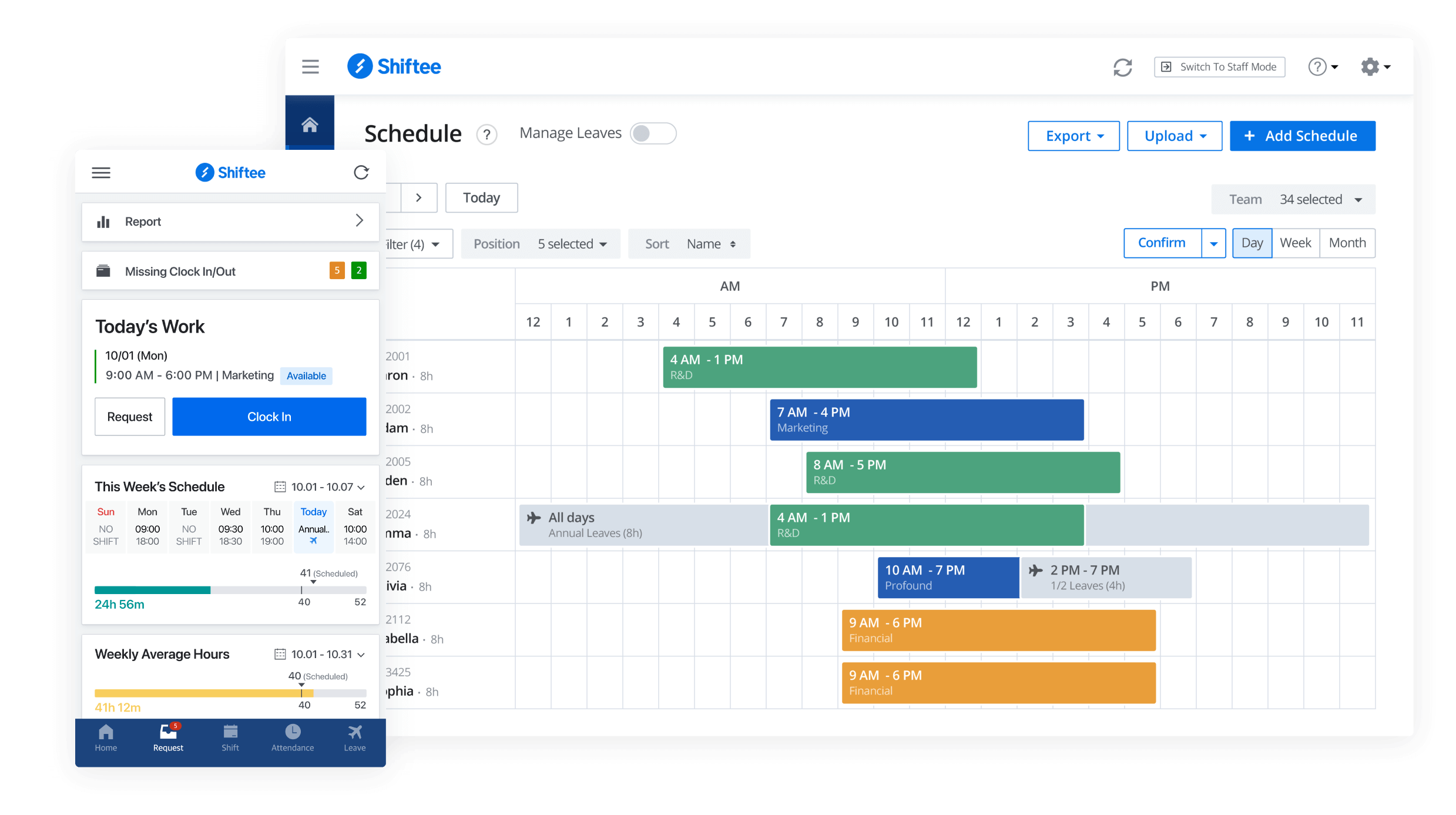
Work schedules for front desk, housekeeping, kitchen, facilities management, and other departments can be managed within a single calendar view. Administrators can review overall schedules using daily, weekly, and monthly calendar views, while permissions can be assigned to departmental managers so schedule creation and updates can be distributed across teams. All departmental schedules are managed under the same system standards, allowing HR and general affairs teams to centrally review and coordinate schedules across the organization.
② Shift Operations and Working Time Calculation
Recurring shift patterns can be saved and used as schedule templates. Administrators can apply patterns by department or role to build schedules, while approved work schedules can be compared with clock-in and clock-out records to calculate overtime, night work, and holiday work according to predefined standards. Break deduction rules can also be configured to apply consistent working time calculation standards.
③ Structured Workflow for Requests and Approvals
Attendance-related requests, including schedule changes, substitute shifts, and leave requests, can be managed through workflow. Approval rules can be configured based on request type, organization, and role, while parallel or sequential approval steps can be set up to match the organization's structure. For recurring requests, optional automatic approval settings can also be used to streamline the request and approval process.
④ Centralized Data and External Integrations
Shiftee supports integration with external systems such as Slack, Google Calendar, and ERP, allowing work schedule and leave information to be managed in connection with other systems. This helps maintain consistent schedule information across platforms and establish a more organized scheduling framework across the organization.
⑤ Support for Multiple Locations and International Employees
Shiftee reflects multi-location organizational structures, allowing work data from headquarters and branches to be managed within a single system. Access permissions can be configured by organization to establish location-level management structures, while multilingual UI support enables overseas offices and international employees to use the same attendance management environment.
Service quality in hotels and hospitality businesses begins with systematic workforce operations. By establishing a data-driven integrated workforce management framework, organizations can manage work schedules and working hours more transparently, while HR teams can make informed workforce management decisions based on real-time work data.
When citing the content, be sure to indicate the source according to copyright law.