Attendance Management for Global Companies in Korea
2026-08-07

As more global companies expand into Korea, organizations are increasingly considering how to align headquarters HR systems with the local employment environment. Korea's working time management and annual leave accrual rules often require detailed configurations, making it difficult in some cases for a global standard system alone to fully support local attendance management requirements.
Attendance management for a Korean branch should be designed with both the local employment environment and data integration with headquarters systems such as ERP in mind. Balancing headquarters reporting requirements with operations based on Korean labor law provides a foundation for consistent HR operations and internal management.
In this article, we review the key criteria and practical considerations global companies should examine when selecting an attendance management system for their Korean branches.
Why Global Companies Need a Local Approach to Attendance Management in Korea
HR systems used by global headquarters are generally designed for multi-country operations. However, reflecting each country's labor laws and employment requirements in day-to-day operations often requires more than simple configuration changes and calls for detailed localization.
In Korea, organizations need to manage daily and weekly working-hour limits as well as overtime, night work, and holiday work separately. They also need to account for requirements associated with various flexible work arrangements, including flexible working hours and selective working hours. Annual leave adds another layer of complexity, as companies often manage accrual based on both employees' hire dates and the fiscal year, while separate accrual rules apply to employees with less than one year of service.
Many Korean workplaces also use workflow-based processes for overtime and holiday work requests and approvals. Companies should therefore consider internal management capabilities such as restrictions on requests that exceed predefined working time standards and detailed approval rules.
For global headquarters seeking to operate Korean branches consistently, it is advisable to consider an attendance management system that can maintain global standards while also reflecting Korean regulations and local operating requirements.
Key Criteria for Attendance Management Systems Supporting Korean Labor Law Requirements
Working Time Calculation and Overtime Management
Accurate working time calculation is a fundamental requirement for operating a Korean branch. The system should be able to compare work schedules with actual clock-in and clock-out records, calculate working hours, and manage overtime, night work, and holiday work separately. It is also advisable to support restrictions on requests that exceed predefined working time standards and manage exceptions through approval processes.
Flexible Configuration for Different Work Arrangements
Companies often need to operate different work arrangements depending on their size and industry. A system should allow work arrangements to be configured by organization, position, and workplace, with scheduled working hours and maximum working-hour rules applied separately where needed. Global companies may also operate headquarters-standard work arrangements alongside local Korean policies, making configuration flexibility an important consideration.
Annual Leave Accrual Rules and Working Time Reconciliation
The system should support annual leave accrual based on either hire date or fiscal year and allow organizations to manage validity periods and expiration dates by leave type. It should also support comparing approved and actual working hours for reconciliation and provide downloadable data, such as Excel files, that can be used in payroll processing.
Headquarters–Branch Data Integration and Global Connectivity
Global companies often integrate HR and attendance data generated by Korean branches with headquarters ERP or HR systems. When branch-level data is managed separately, additional reconciliation may be required for global reporting or labor cost analysis. ERP integration, Open API support, and SSO capabilities are therefore important considerations when selecting a system.
Security and Authentication
Global companies typically apply strict information security standards. International certifications such as ISO/IEC 27001, IP access controls, administrator audit logs, and SSO-based access are important factors to consider when selecting a system. Location- or Wi-Fi-based authentication and one-to-one mobile device assignment can also help improve the reliability of clock-in and clock-out records.
Shiftee: Integrated Workforce Management for Global Integration
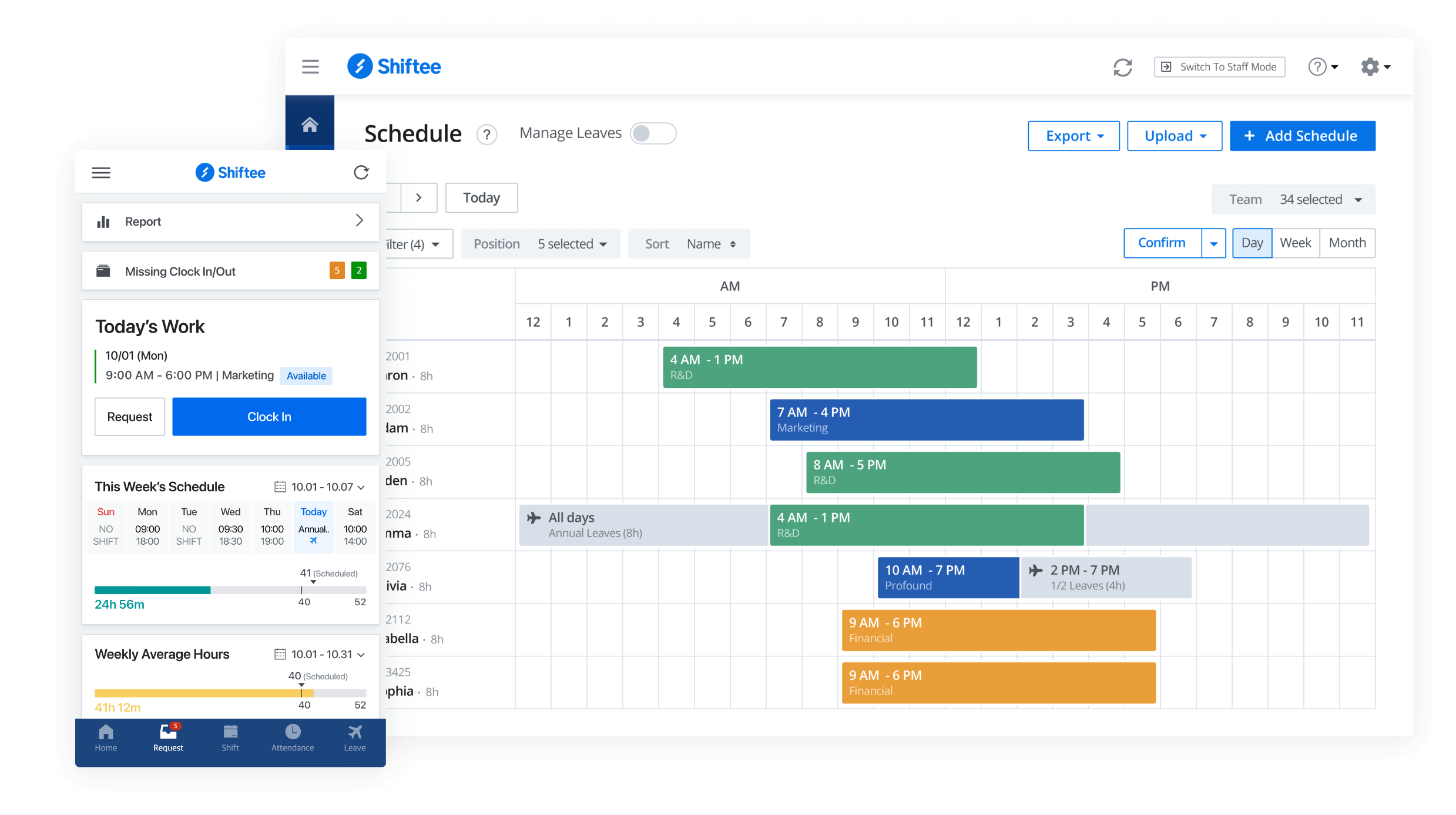
Shiftee is a workforce management solution designed to support attendance management in Korea while also considering integration with global ERP environments. It supports integration with SAP, Workday, and Oracle ERP, as well as SSO-based authentication, enabling organizations to manage detailed settings for Korean branches while connecting with headquarters systems.
1. Integrated Attendance Management
Work schedules, clock-in and clock-out records, working time reconciliation, leave management, workflow-based requests and approvals, and PC-based working time management can all be connected within a single system. Rather than operating separate systems for each function, organizations can manage attendance-related data within an integrated structure and maintain branch-level operations through a single solution.
2. Configuration for Korean Working Time Requirements
Shiftee supports separate management of overtime, night work, and holiday work and allows work arrangements and approval rules to be configured by organization and position. Companies can reflect their own work arrangement policies and working time management standards in the system, including detailed operating rules based on workplace or position, helping maintain a consistent attendance management framework for Korean branches.
3. Global ERP and Data Integration
Shiftee supports integration with SAP, Workday, and Oracle ERP, along with Open API-based data connections, allowing data to flow between branches and headquarters systems. This helps organizations systematically connect attendance and HR data needed for global reporting.
4. SSO and Security Settings
Shiftee supports SSO with Okta, Microsoft Azure, and OneLogin, along with IP access controls and audit logs. This allows companies to maintain account management aligned with headquarters authentication policies while applying security settings suited to Korean branch operations.
Attendance management for a Korean branch of a global company goes beyond recording clock-in and clock-out times. It is a strategic area that needs to account for both Korean labor law requirements and global reporting structures. Because Korea's working time and leave systems require detailed configurations, companies should consider a localized management framework while also supporting global standards such as ERP integration and SSO.
Shiftee is an integrated workforce management solution designed to support operational requirements based on Korean labor law. It supports separate management of different working-hour categories and various work arrangements, while ERP and Open API integration enable data connections with global systems. SSO-based security also supports consistent authentication between headquarters and Korean branches.
Shiftee is currently used by Korean entities of global companies, including SharkNinja Korea LLC and AliExpress, as an attendance management system for operations in Korea.
If you need an attendance management system that supports both Korean labor law requirements and global ERP integration, consider adopting Shiftee to build an operating framework tailored to your organization.
When citing the content, be sure to indicate the source according to copyright law.