Media Industry Attendance Management for Freelancers and Contractors
2026-07-22

- Why Attendance Management Matters More in the Media Industry
- Attendance Management for Freelancers in Project-Based Production
- Key Challenges in Attendance Management for Contract Employees
- Criteria for Choosing an Integrated Attendance Solution for the Media Industry
- Integrated Attendance Management for Freelancers and Contractors with Shiftee
The rapid growth of OTT platforms, digital content production, and increasingly project-based production environments is reshaping workforce structures across the media industry. Rather than relying primarily on permanent employees, more organizations now operate with flexible combinations of freelancers and contract employees assigned by project.
As this workforce structure changes, attendance management in the media industry also needs to evolve. Traditional attendance systems designed mainly for permanent employees may not be well suited to managing both freelancers and contract employees consistently.
In this article, we look at the characteristics and challenges of attendance management in the media industry and outline key criteria and strategies for adopting a solution that can support both freelancer and contract employee attendance management within an integrated framework.
Why Attendance Management Matters More in the Media Industry
Media industry workforces are often formed and reorganized around individual projects. Different people may be needed for filming, editing, post-production, broadcasting, and other stages, while short-term contracts and freelance arrangements are common.
As a result, attendance management in the media industry needs to go beyond basic clock-in and clock-out records and consider both project-level working time calculations and management standards by contract type. Freelancers often work primarily on-site, while contract employees may require clear working time calculations when their contract periods end.
In fast-paced production environments, working time management can sometimes become a lower operational priority. Over the long term, however, establishing a systematic attendance management framework can help support more stable operations across the media industry.
Attendance Management for Freelancers in Project-Based Production
Freelancer attendance management differs from typical office-based attendance management. Work may take place across filming locations, external studios, regional locations, and other worksites, while working hours may also vary significantly.
In these environments, it is important not only to record attendance but also to calculate working hours in connection with project schedules. For example, even if a freelancer works extended hours on a particular filming day, accumulated working hours should be manageable at the project level.
Working time calculation standards may also vary depending on the freelancer's contract terms, making flexible configuration of work arrangements and schedules important. Simply recording whether someone entered or left a workplace may not be sufficient for the attendance management needs of the media industry.
Key Challenges in Attendance Management for Contract Employees
Attendance management for contract employees requires clearly defined standards because their contract periods have specific start and end dates. Working hours between the contract start and end dates, overtime and night work, and leave usage should all be recorded clearly.
In the media industry in particular, project completion and contract expiration often occur around the same time. Without a structured approach to attendance management, this can create confusion during working time calculations at the end of a contract.
When contract employees participate in multiple projects at the same time, organizations may also need a structure that separates and aggregates working hours by project. Attendance management for contract employees therefore needs to be connected with project-level data management rather than treated simply as headcount administration.
Criteria for Choosing an Integrated Attendance Solution for the Media Industry
For attendance management in the media industry, it is advisable to consider the following criteria.
First, the system should allow work schedules to be configured and managed by project. Supporting both freelancer and contract employee attendance management requires a structure that can distinguish different work arrangements.
Second, the system should support on-site and off-site employees. The ability to configure multiple workplaces and manage different work arrangements is important for media industry environments.
Third, working time calculation and reporting should be clearly structured. Organizations should be able to finalize contract employee attendance data at the end of a contract period and aggregate freelancer working time by project.
Integrated Attendance Management for Freelancers and Contractors with Shiftee
Shiftee supports integrated attendance management for freelancers and contract employees in project-based workforce environments across the media industry.
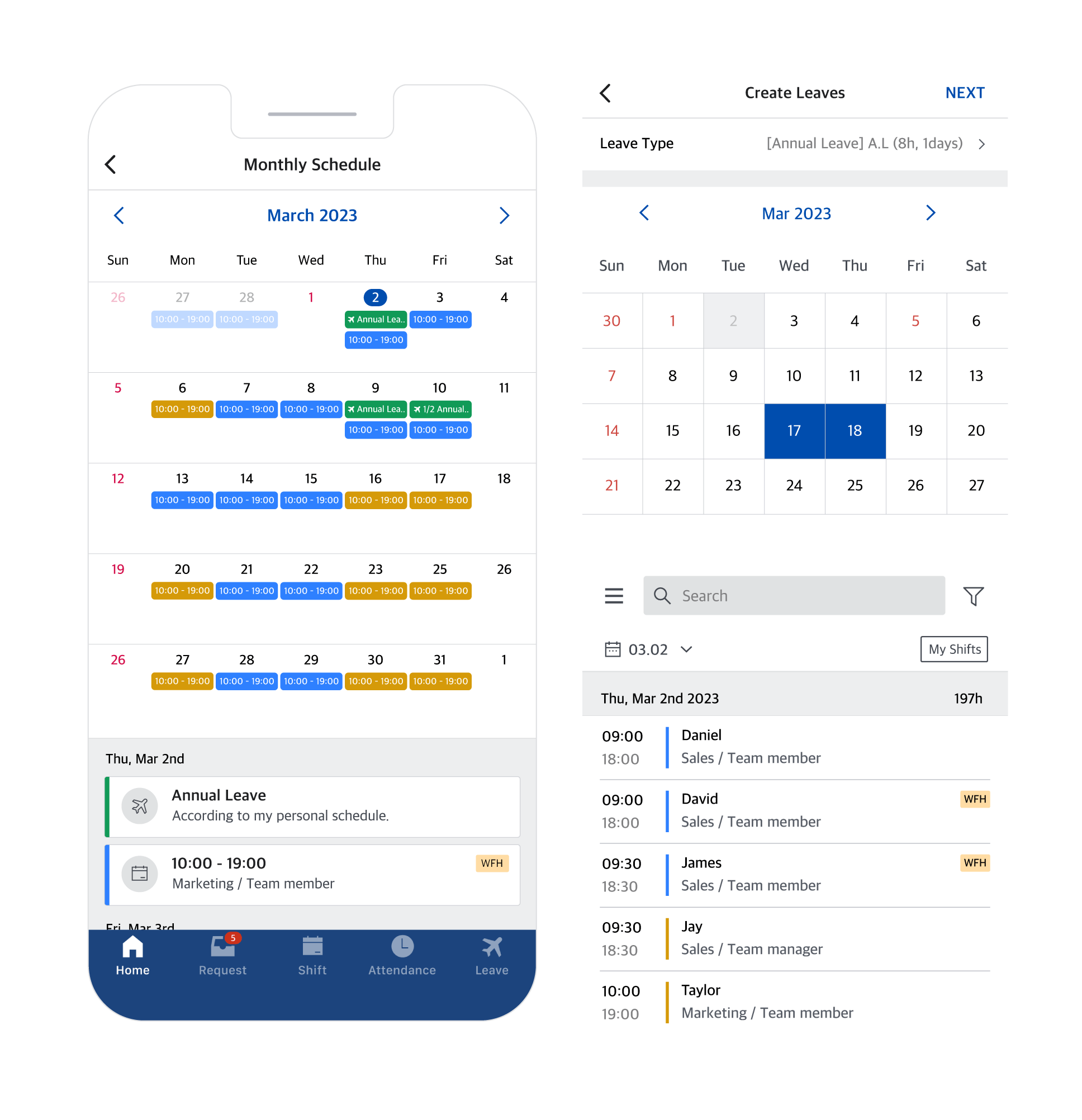
1. Project-Based Work Schedules and Schedule Patterns
Because media workforces are often organized around projects such as filming, editing, and post-production, work schedules need to be configurable based on project periods. Shiftee provides daily, weekly, and monthly calendar views and schedule pattern settings, allowing organizations to distinguish work schedules by configuring work arrangements for specific project periods. This makes it possible to manage freelancers and contract employees under separate work arrangements and respond flexibly to recurring short-term contracts.
2. Multiple Workplaces and Off-Site Work Management
In the media industry, employees may work across filming locations, studios, and external sites, making workplace configuration particularly important. Shiftee allows multiple workplaces to be configured by organization or branch and supports requests for clock-ins and clock-outs outside designated workplaces. This helps organizations systematically manage working time records for freelancers working on-site and also supports contract employees who frequently work off-site.
3. Break Deductions and Working Time Calculation Settings
Because long working hours may occur depending on production schedules, it is important to define clear break deduction standards. Shiftee can configure break deductions based on total working hours or specific times and also supports manual break records for individual employees. This allows organizations to manage differences in working time calculation standards for freelancers and contract employees in greater detail.
4. Working Time Requests and Approvals Through Workflow
Finalizing working hours is especially important when projects or contract periods end. With Shiftee's workflow, organizations can systematically manage requests for clock-ins and clock-outs at off-site workplaces, overtime, night work, holiday work, and annual leave in full-day, half-day, quarter-day, and hourly units. Approval rules can be configured by request type, organization, and role, allowing companies to design approval structures at the project level.
5. Working Time Calculations and Custom Reports
Project-level and contract-type working time calculations are important in media industry attendance management. Shiftee allows approved working hours to be compared with actual working hours and supports calculations for average daily, weekly, and monthly working hours as well as overtime management. Custom reports also allow organizations to configure specific data fields, making it possible to review freelancer and contract employee attendance data separately.
The key to attendance management in the media industry is achieving both flexibility and accuracy. Rather than managing freelancers and contract employees separately, it is more efficient to manage contract types and project-based work within a single integrated framework.
Shiftee supports freelancer and contract employee attendance management in the media industry through project-based work schedule settings, multiple workplace and off-site work management, break deductions and working time calculations, workflow-based requests and approvals, and working time calculation and custom reports.
If you are looking to manage freelancer and contract employee attendance more consistently within the same organization, consider adopting Shiftee as an integrated attendance management solution designed to support the needs of the media industry.
When citing the content, be sure to indicate the source according to copyright law.