Part-Time Attendance App Guide: Scheduling & Payroll
2026-09-01

Workplaces that rely heavily on part-time employees, such as restaurants, retail stores, logistics operations, and event businesses, often have highly variable staffing needs. Employees may change from day to day, staffing levels may increase on weekends and during peak seasons, and working hours may vary by store. In these dynamic environments, clear management standards are important for operating attendance management and payroll processing more systematically.
Attendance management for part-time employees should bring together planned work schedules and actual working time records within a structure that also supports payroll processing. In this article, we look at how to integrate scheduling and payroll operations and review the key criteria for choosing an attendance management app for part-time employees.
The Complexity of Attendance Management and Payroll for Part-Time Employees
Unlike full-time employees, part-time employees often work different days and hours from week to week. Work schedules may change frequently depending on store operations, while replacement shifts and shift changes are also common. As a result, differences can easily arise between planned work schedules and actual clock-in and clock-out records, requiring additional review during payroll processing.
In businesses with long operating hours, such as restaurants and retail stores, overtime, night work, and holiday work may occur in combination. Premium pay requirements may vary depending on when employees work, while the method used to deduct break time can also affect the calculation of actual working hours. Weekly holiday pay also depends on whether weekly working-hour requirements are met, so daily clock-in and clock-out records alone may not always provide enough information for accurate calculations.
Attendance management for part-time employees therefore goes beyond recording when employees start and finish work. It involves systematically managing the data used for payroll processing, including working hours, break times, and overtime, night work, and holiday work. If work schedules, clock-in and clock-out records, break times, and approval histories are managed separately, HR teams may need to compare multiple sources again during payroll processing. Establishing a structured operating environment that manages attendance data according to consistent standards can help support accurate payroll processing.
Why Scheduling and Payroll Should Be Managed Together
-
Easier comparison of planned schedules and actual working hours: Managing work schedules together with clock-in and clock-out records makes it easier to compare planned and actual working hours at a glance. This can reduce additional reconciliation during payroll processing and provide clearer standards for working time calculations.
-
Consistent management of overtime, night work, and holiday work: A schedule-based working time calculation framework allows organizations to apply consistent aggregation standards to different categories of working time. This helps maintain structured working time data for payroll processing.
-
More efficient weekly working time reviews: Items such as weekly holiday pay require review based on weekly working hours, making weekly aggregation important. Managing schedules and attendance data together makes it easier to review total weekly working hours and can improve the efficiency of payroll reviews.
-
Clear break time management standards: Break deduction rules directly affect the calculation of actual working hours. Managing break times in connection with work schedules allows organizations to apply consistent working time calculation standards and use more accurate data for payroll processing.
-
Consistent standards across multiple stores: For businesses operating multiple stores, scheduling practices and attendance management standards may vary by location. An integrated management framework allows data to be managed according to consistent standards by organization and position, supporting more consistent attendance and payroll operations for part-time employees.
How to Choose an Attendance App with Payroll in Mind
1) Structured Work Schedule Management
An attendance management app for part-time employees should support daily, weekly, and monthly work schedules. It is advisable to check whether the system can accommodate recurring schedules, shift work, replacement shifts, and other work arrangements. The process and approval histories for creating and changing work schedules should also be managed systematically to maintain consistent working time calculation standards.
2) Clock-In and Clock-Out Management and Working Time Comparison
Check whether the system supports standards for managing clock-in and clock-out records through methods such as location or WiFi authentication and one-to-one mobile device assignment. Another important consideration is whether planned work schedules can be compared with actual clock-in and clock-out records to identify differences in working time.
3) Break Time and Overtime Management
It is important to check whether break deduction rules can be configured. Break times should be manageable based on total working hours or specific times, while overtime, night work, and holiday work should be aggregated separately. These settings provide the underlying data used for working time calculations and payroll processing.
4) Working Time Aggregation and Payroll Use
It is advisable to check whether the system provides working time aggregation by day, week, and month. Companies should also review whether approved working hours and actual working hours can be reviewed together. Using attendance data directly in payroll processing can improve the efficiency of payroll reviews.
5) Data Use and System Integration
Check whether attendance data can be downloaded in Excel format and integrated with external systems such as ERP. Reviewing payroll statement delivery capabilities and how related data can be used can also help organizations build a more connected workflow from attendance management through payroll processing.
How Shiftee Streamlines Attendance and Payroll for Part-Time Employees
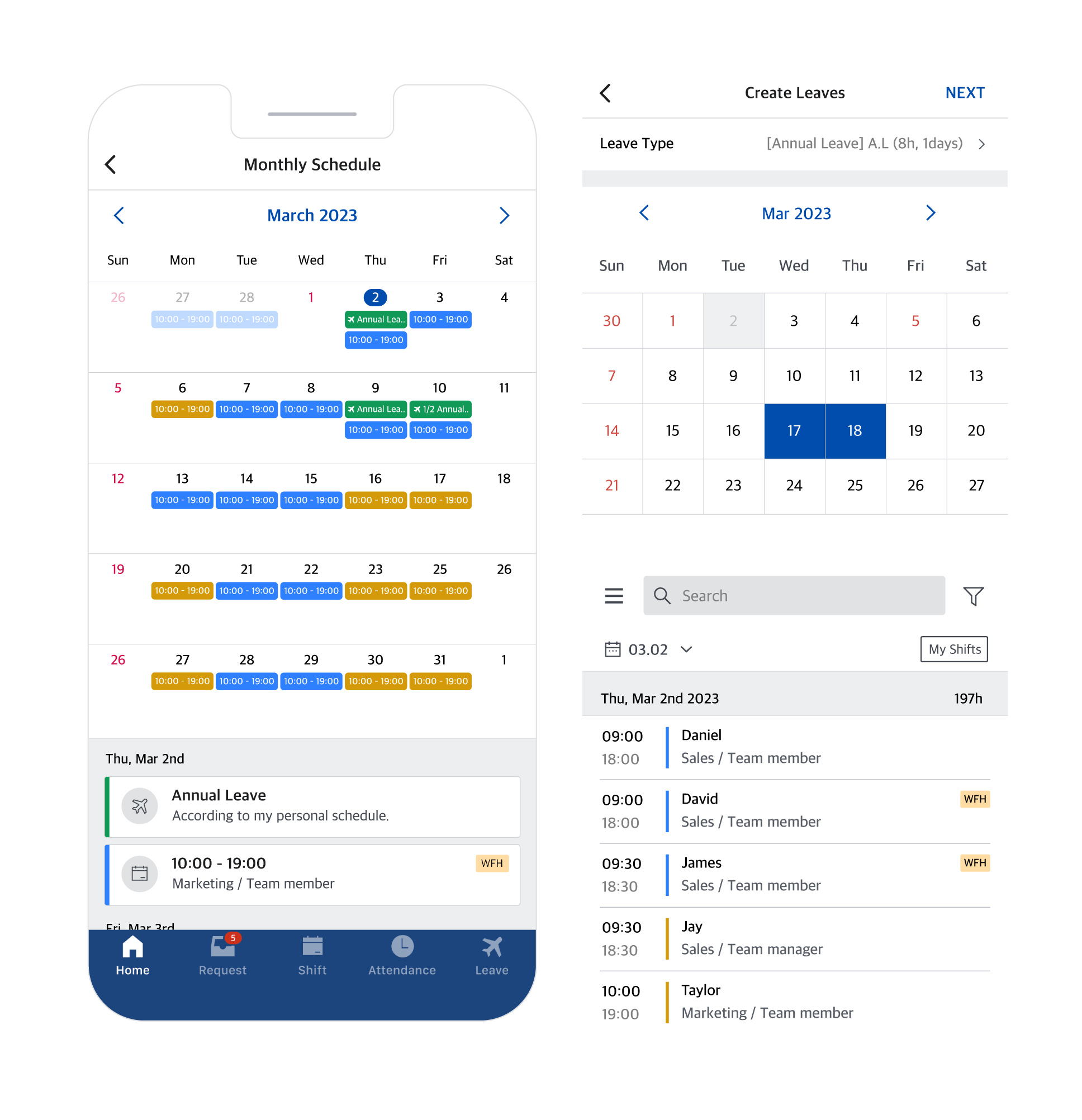
Build a Schedule-Based Work Schedule Management Framework
Work schedules can be managed by day, week, and month, while schedule patterns can be used for recurring work and shift schedules. Approval steps can also be configured for the creation and changes of work schedules, enabling step-by-step requests and approvals through workflow. Change histories can be reviewed and managed within Shiftee, helping organizations maintain consistent working time calculation standards.
Manage Clock-In and Clock-Out Records with Coordinate and WiFi Authentication
Coordinate or WiFi authentication and one-to-one mobile device assignment can be used to manage clock-in and clock-out records more accurately. Assigning each employee account to a single mobile device can help prevent proxy clock-ins, while differences between planned work schedules and actual clock-in and clock-out records can be reviewed as reference data for working time calculations.
Manage Overtime, Night Work, and Holiday Work
Approved working hours can be compared with actual working hours, while overtime, night work, and holiday work are calculated separately based on configured standards. Working time aggregation by day, week, and month also provides structured data that can be used for attendance management and payroll processing.
Support Payroll Processing with Integrated Attendance Data
Attendance data, including work schedules, clock-in and clock-out records, break times, overtime, night work, and holiday work, can be used for payroll processing. Shiftee supports payroll processing based on attendance data and allows payroll to be managed for different employment types, including salaried employees, hourly employees, daily workers, and freelancers.
Send Payroll Statements and Manage Payroll Data
Payroll statements can be sent in bulk using Shiftee's message feature, while delivery histories and whether employees have read them can also be checked. Payroll registers, payroll reports, and net pay data can be used to manage payroll-related information systematically.
Manage Part-Time Employees Across Multiple Stores
Employee information and hire and termination dates for part-time and short-term employees can be managed within a single solution. Simple employee addition and deactivation features also support work environments with frequent workforce changes. Team- and branch-level management and employee status views across multiple stores help companies operating several locations manage their workforce more systematically.
When choosing an attendance management app for part-time employees, it is advisable to review not only scheduling capabilities but also clock-in and clock-out management, working time aggregation, payroll processing, payroll statement delivery, and external system integration. When these functions are connected, organizations can manage attendance data reviews and payroll operations more efficiently.
Shiftee is an integrated workforce management solution used across a range of industries, including food service, retail, logistics, and service businesses. Work schedules, clock-in and clock-out records, working time aggregation, payroll processing, and payroll statement delivery can all be managed within a single system.
If you are considering an attendance management app for part-time employees, consider adopting Shiftee to establish a workforce management framework suited to your organization.
When citing the content, be sure to indicate the source according to copyright law.