Integrated Attendance Management for Diverse Work Models
2026-06-02

Attendance management used to be simple because most employees arrived at and left the same workplace at the same time. Today's work environment, however, is changing rapidly. Startups encourage creative cultures through flexible work arrangements, while large enterprises are improving productivity by adopting hybrid work and staggered working hours.
As work arrangements become more diverse, the administrative burden and legal risks facing HR teams also increase. In particular, changes in government labor policies, including the roadmap for reducing working hours and measures to prevent the misuse of inclusive wage systems, require companies to establish more sophisticated attendance management frameworks.
Why Attendance Management Becomes More Complex with Diverse Work Arrangements
Recent policy direction from the Ministry of Employment and Labor emphasizes both ‘greater flexibility in working hours’ and ‘accurate records.’ As a result, companies with diverse work environments face several common challenges.
-
Gaps in management coverage: As work from home, off-site work, and satellite offices become more common, conventional fingerprint scanners or office access cards may not be sufficient to verify actual work status. This can lead to questions over transparency when calculating overtime pay.
-
Complex annual leave and allowance calculations: Different employment contract terms by job category can make annual leave accrual and overtime allowance calculations more complex. Managing these processes through spreadsheets or manual methods increases the risk of human error and can also become a source of wage-related disputes.
-
Flexible work arrangements becoming administrative formalities: Without adequate system support, employees may have to prepare manual reports or managers may need to organize attendance data manually. In such cases, the autonomy and efficiency that flexible work arrangements are designed to provide may not be fully realized.
How to Operate Integrated Attendance Management Across Diverse Work Environments
Experts increasingly emphasize the need to move from ‘attendance management for recordkeeping’ to ‘data-driven integrated workforce management.’ To operate integrated attendance management effectively, companies should consider the following three approaches.
-
Build a multi-authentication framework without location constraints: Companies should adopt mobile-based authentication so employees can verify their work status regardless of where they work. Location-based clock-in and clock-out authentication and Wi-Fi authentication can provide an integrated recordkeeping framework across headquarters, off-site locations, and work-from-home environments.
-
Manage working hour limits and provide real-time notifications: To support compliance with the 52-hour workweek, employees should receive advance notice during schedule planning before reaching working hour limits, allowing managers and employees to adjust working hours proactively. This contributes not only to regulatory compliance but also to protecting employee health and improving work efficiency.
-
Streamline Requests and Approvals with Workflow: Attendance-related decisions, including leave, overtime, and off-site work requests, should be recorded as data and flow directly into payroll processing without additional manual processing. This can reduce the administrative burden on HR teams while improving the transparency of HR data.
Integrated Attendance Management with Shiftee
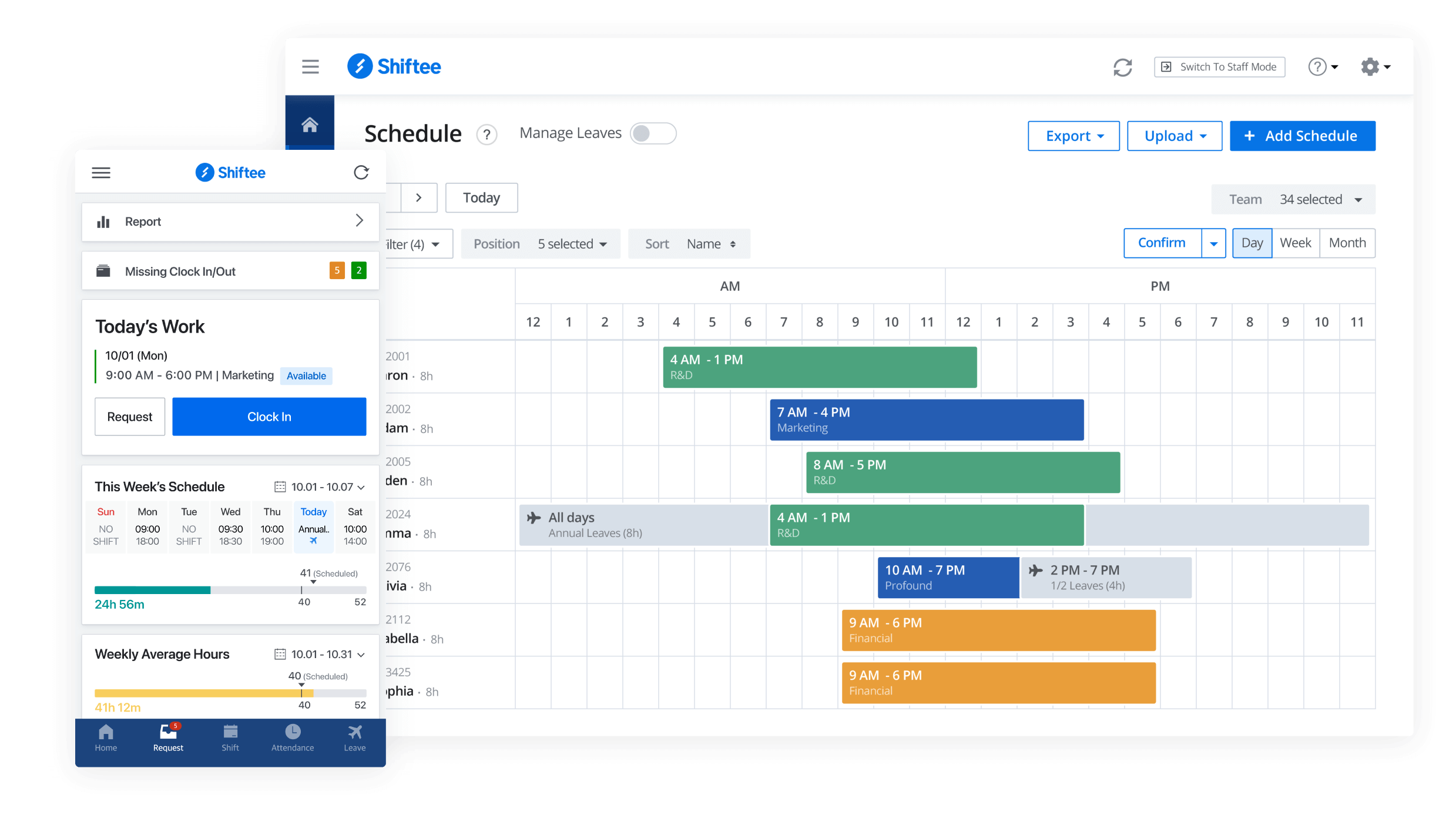
1. Flexible Configuration for Diverse Work Systems
Shiftee allows companies to easily configure various work systems within a single platform, including selective working hours, flexible working hours, and staggered working hours. It also supports the 52-hour workweek, shift work, and work from home, with configurations that can be customized to reflect each company's work rules.
2. Greater Transparency with Location and Wi-Fi Authentication
Shiftee uses location and Wi-Fi authentication to verify employees' work locations. Across diverse work arrangements, including off-site work, dispatched work, and work from home, these authentication methods help prevent buddy punching and provide reliable working time data.
3. A Digital Work Environment with Integrated Workflows
Attendance-related requests and approvals, including work schedule changes, leave requests, and overtime requests, are managed within a single workflow, helping streamline HR processes and improve operational efficiency.
4. Automatic Data Aggregation and Payroll Integration
Approved attendance records are automatically calculated and connected with payroll systems. HR teams can generate payroll-related reports with a single click, significantly reducing administrative workload.
Shiftee is a cloud-based SaaS solution that supports everything from the flexibility required by startups to the sophisticated workforce management needs of large enterprises. It can be adopted without complex installation and synchronizes data between headquarters and branch offices in real time.
Attendance management is no longer simply an administrative function. It has become a key management area that can influence organizational trust and workplace culture. With Shiftee, transform attendance management into a data-driven foundation for communication and trust.
When citing the content, be sure to indicate the source according to copyright law.