Shiftee Releases 2025 Work Hours Trend Report
2026-05-28
- Average clock-in 8:42 AM, clock-out 6:19 PM; clock-in times have continued shifting earlier year over year
- Clock-in times span nearly 2 hours across industries; clock-out times concentrate around 6 PM
- Shiftee Releases 2025 Work Hours Trend Report
- Shiftee, Integrated Workforce Management Solution, Releases Clock-In/Out Data Analysis
Press Coverage
Shiftee (CEO SeungWon Shin), an integrated workforce management solution provider, released its 2025 Work Hours Trend Report on the 28th, based on platform data from January 1 to December 31, 2025.
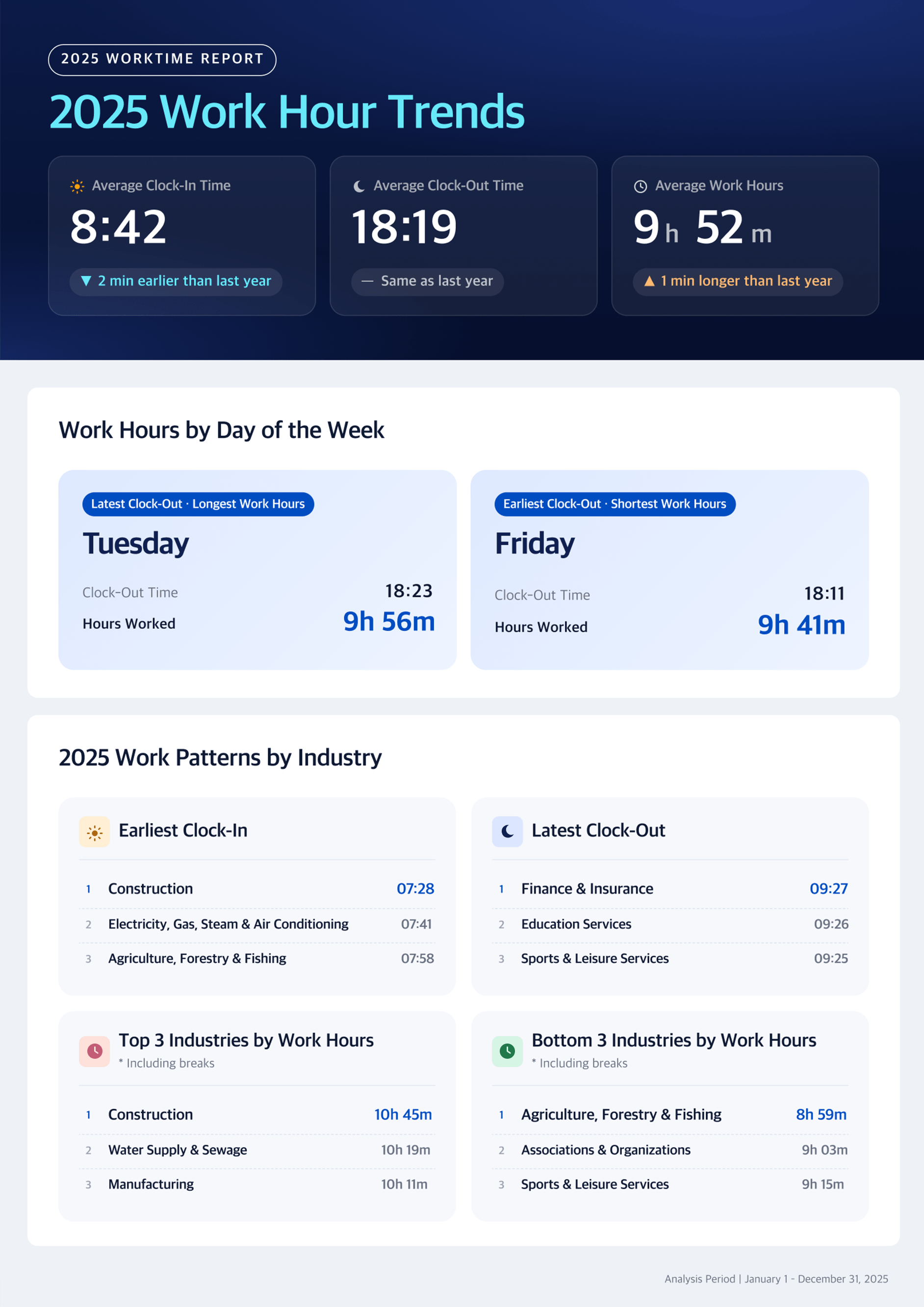
In 2025, the average clock-in time among Korean workers was 8:42 AM — 2 minutes earlier than the previous year. Clock-out time remained unchanged at 6:19 PM, but the earlier start pushed average daily work hours (including breaks) up by 1 minute to 9 hours and 52 minutes. Since Shiftee first began this analysis in 2021, clock-in times have moved 19 minutes earlier while clock-out times have shifted by only 10 minutes. With clock-in times shifting more than clock-out times, average work hours have grown by 7 minutes over four years — up from 9 hours and 45 minutes in 2021.
Clock-in times in 2025 were virtually identical across the week, falling between 8:42 and 8:43 AM regardless of the day. Clock-out times, however, varied noticeably. Workers left latest on Tuesdays (6:23 PM) and earliest on Fridays (6:11 PM). Work hours followed the same pattern — longest on Tuesdays at 9 hours and 56 minutes, shortest on Fridays at 9 hours and 41 minutes — confirming a consistent gap in work hours by day of the week.
Industry differences were most visible in clock-in times. Construction recorded the earliest average at 7:28 AM — 1 hour and 14 minutes ahead of the overall average — followed by Electricity, Gas, Steam & Air Conditioning (7:41 AM) and Agriculture, Forestry & Fishing (7:58 AM). Industries that are field-based or sensitive to daylight hours and energy demand showed the strongest tendency toward early starts.
In contrast, office and service-oriented industries generally clocked in after 9 AM. Finance & Insurance (9:27 AM), Education Services (9:26 AM), and Sports & Leisure Services (9:25 AM) recorded the latest clock-in times, reflecting schedules built around customer service and business operating hours. In terms of clock-in times alone, the gap between Construction and Finance & Insurance reached nearly 2 hours.
Industry differences extended to total work hours as well. Construction logged the longest average at 10 hours and 45 minutes (including breaks), followed by Water Supply & Sewage (10 hours and 19 minutes) and Manufacturing (10 hours and 11 minutes) — all exceeding 10 hours. Agriculture, Forestry & Fishing recorded the shortest at 8 hours and 59 minutes, the only industry to fall below 9 hours. Associations & Organizations (9 hours and 3 minutes) and Sports & Leisure Services (9 hours and 15 minutes) followed.
What stands out is that while clock-in times varied by up to 2 hours across industries, clock-out times were concentrated between 6:00 PM and 6:47 PM for most industries. Construction averaged 5:46 PM — among the earliest, along with Real Estate at 5:48 PM. Even the latest industry — Water Supply & Sewage — finished by 7:00 PM, showing that clock-out times across industries tend to converge around 6 PM.
“The data shows that work schedules among Korean workers follow clear structural patterns — shaped by both the day of the week and the industry,” said SeungWon Shin, CEO of Shiftee. “When organizations use workforce data not simply as a record, but as a core resource for running their business, they can manage their workforce in ways that truly fit the nature of their industry and roles.”
When citing the content, be sure to indicate the source according to copyright law.