7 Key Criteria for Choosing an Attendance Management System
2026-03-30

In a rapidly evolving work environment shaped by increasingly rigorous legal standards, attendance recording systems have moved well beyond their original function as simple timekeeping devices — they now serve as a foundational layer of operational infrastructure.
At the same time, the proliferation of remote work, staggered clock-in/clock-out schemes, and shift-based arrangements has made it necessary for attendance recording to become equally flexible. Managing this complexity through manual records or a single rigid method can limit operational flexibility.
Criteria for Selecting an Attendance Recording System
The range of available attendance recording solutions is wide. Unlike the standardized work environments of the past, today's organizations operate across a mix of office-based, field-based, shift, and remote arrangements — often simultaneously. No single approach fits all organizations, which means the central selection criterion is whether the system can adapt flexibly to your organization's specific workflow and workforce structure.
In an environment where regulations and institutional policies change frequently, the decision should not rest on feature count alone. Configuration flexibility and ease of operation — the ability to respond quickly to change — must be factored in equally. More than price or brand recognition, what ultimately determines user satisfaction is how accurately the system records attendance and how easily it can be managed day to day.
7 Checkpoints for Evaluating an Attendance Recording System
① Accuracy: Reliable Authentication Technology and Security
The first question to ask when evaluating any attendance recording system is whether it is capable of producing accurate records. Because recording can be affected by an employee's location, network environment, and other variables, the reliability of the authentication method and its resistance to external manipulation require careful scrutiny. How effectively the system addresses real-world risks — such as proxy clock-ins or location spoofing apps — is a meaningful indicator of overall quality.
- Shiftee: Supports location-based and Wi-Fi-based clock-in/clock-out, with location spoofing app blocking and one-device-per-employee assignment to ensure record integrity.
② Suitability for Your Work Environment: Support for Diverse Work Arrangements
Clock-in/clock-out recording is not simply about capturing a timestamp — it must operate in alignment with the organization's work policies. In organizations where shift work, field assignments, remote work, and staggered hours all coexist, the schedule, recording method, and working hour calculation approach for each arrangement must work together seamlessly. Solutions optimized for only one type of work arrangement can become a constraint when policies change, so flexibility and scalability are equally important considerations.
- Shiftee: Supports diverse workforce structures through flexible scheduling tools. Shift Templates for recurring patterns, timeclock area management for multi-site teams, and automated shift rotation through schedule patterns.
③ Operational Usability: Convenience for Both Administrators and Employees
Even a feature-rich system will underperform in practice if it is difficult to use. Employees must record their attendance daily; administrators must handle approvals, reviews, and correction requests. The intuitiveness of the UI, the layout of core functions, and the flow of notifications all matter. It is also important to verify that the system works smoothly across both mobile and desktop, and that error handling and correction processes are clearly defined.
- Shiftee: Available seamlessly across mobile and desktop. Automated notifications, clock-in/clock-out record edit requests, and electronic approval workflows enhance day-to-day usability for all users.
④ Data Integration and Scalability: Compatibility with Existing Systems
Clock-in/clock-out records do not exist in isolation — they feed into HR, payroll, accounting, and other business functions. Integration with ERP systems, access control platforms, and collaboration tools is necessary for attendance data to connect naturally within the broader workflow. Whether the system fits with existing infrastructure, and whether API access or customization options are available, are important evaluation points.
- Shiftee: Integrates with a wide range of platforms including ERP, google calendars, and access control systems, and connects easily with proprietary internal systems through Open API.
⑤ Security and Personal Data Protection: Authentication Standards and Data Handling Policies
Attendance recording systems handle sensitive information — including location data and working hours — so it is essential to verify that data protection standards meet applicable regulatory requirements. Encryption, access controls, audit logging, and data retention and disposal policies must all be systematically established.
- Shiftee: Applies AES-256 encryption, IP-based access restrictions, audit logs, and an immediate-disposal policy for location data. Shiftee is also registered as a location-based service provider, satisfying the relevant regulatory requirements.
⑥ Payroll Calculation and Reporting: Level of Operational Automation Support
Clock-in/clock-out data must translate into working hour calculations and payroll calculation of overtime, overnight, and holiday hours. How collected data is processed and automated therefore has a direct impact on HR practitioners' day-to-day efficiency. The range of available reports, customization options, and whether outputs reflect current statutory requirements are all worth examining.
- Shiftee: Eliminates manual payroll prep by automatically calculating worked hours, overtime and night work, and generating comprehensive reports—ready for payroll processing.
⑦ Operational Efficiency: Fast Implementation and Ongoing Maintenance
Once adopted, an attendance recording system is typically in use for years. It is therefore important to assess how quickly the system can respond to change — whether settings alone can accommodate regulatory shifts without custom development. Implementation speed and the maintenance model are also meaningful selection criteria.
- Shiftee: A cloud-based SaaS solution that can be implemented immediately without installation. System maintenance and feature updates are included, ensuring operational stability. Organizations with multiple locations can manage all sites centrally from head office, enabling efficient organization-wide operations.
Key Attendance Recording Features Offered by Shiftee
Shiftee goes beyond basic recording functionality, offering broad support for the capabilities most likely to improve operational reliability across day-to-day HR management.
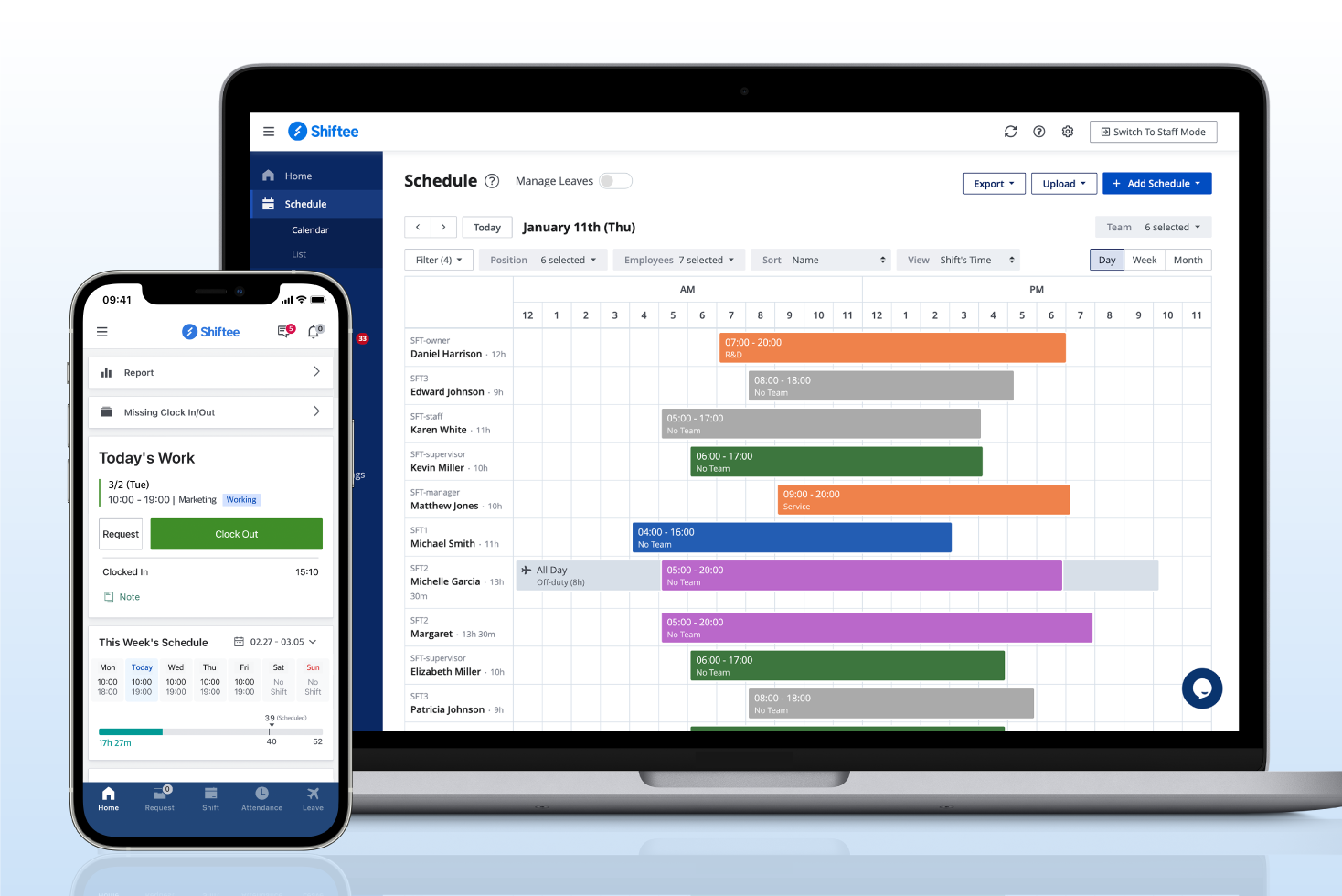
- Accurate records through location-based or Wi-Fi-based clock-in/clock-out
- One-device-per-employee assignment and proxy clock-in prevention
- Support for diverse work arrangements including office, field, and shift-based roles
- Automated Approval workflows for Leave, attendance adjustments, and custom requests—eliminating manual routing and delays.
- Working hour calculation and custom report generation
- Integration with ERP, access control systems, collaboration tools, and more
- SaaS-based implementation with no installation required, supporting unified organizational management
An attendance recording system is far more than a tool for recording arrival and departure times. It is a core operational infrastructure — one that connects attendance accuracy, diverse work arrangement support, HR automation, and regulatory risk management into a single framework.
Shiftee is an integrated workforce management solution that covers not only accurate clock-in/clock-out recording, but also electronic approval workflows, leave management, payroll calculation, reports, and external system integration — all within one platform. By connecting diverse HR functions organically within a single system, practitioners gain management efficiency and organizations achieve greater operational transparency.
Start building a workforce management environment optimized for your organization — beyond attendance recording — with Shiftee.
When citing the content, be sure to indicate the source according to copyright law.